poetry and asphalt ... worship and ritual
 Today
Today is common to want to get a good physical appearance and in the subject no one can match Brazil, especially its beaches, which is definitely a place where one does nothing but run into spectacular bodies, perfect care , this is because it is part of their culture, the cult of the body is nothing short of an obligation in Brazil, is practiced almost religiously by the majority of Brazilians still common in both men and women, is part of their identity and is totally ubiquitous, it is normal to see in all spheres of society without exception, in all ages, from young people, to more advanced age, all identified with the same purpose.
Some practice this culture of pampering for a health issue or because they practice a sport but for the vast majority is simply to improve their physical appearance, for the vanity of seeking the dream body, look good and largely by staying young, the latter point is very important, because this search for youth, mark an end to the "age", ie is not the biological age that matters, but the important thing is to pretend be as young as possible, which is why they are also much sought after plastic surgeons as well as new treatment appears to reduce the visibility of the passage of time and drugs for weight reduction.


But also in the case of Brazilian women are known to use much of their time on improving their appearance in order to excel at work as well as today their physical appearance allows them to get some additional advantage to excel in that area and especially if it comes to competing with men.
For some, the cult of the body in Brazil today is an issue, because they have been increasing cases in which the search for the ideal figure becomes a pathology, this happens mostly in teenagers, with case anorexia and bulimia, diseases in Brazil are alarming, there are also cases of sales of drugs to lose weight, where Brazil is the country with the largest amount of production and consumption in the world.
authorities are already taking appropriate action to reverse this reality.
...

understood as cultural consumption, the practice of 'cult of the body "stands today as a general concern that cuts across all sectors, social classes and age periods, based on a speech he made hand now the question aesthetics, now is concerned about health.
Yet general concern about the cult of the body is present in all segments of society, the way this is set within each group is diversified.
The choice of the sport of gymnastics, dance and the academy / gym to practice, is associated, probably, to other spheres of life and other elections in the goods market.
As demonstrated Bourdieu, body language is a sign of social distinction, occupying a key position in his argument and theory building, placing the food consumption, cultural and presentation (including consumption apparel, beauty products, hygiene and care and handling of the body in general) as the three most important ways to distinguish, is, as they are revealing of the deeper structures of the habitus certain and decisive.

"The body is the objectification of irrefutable class taste, manifested in different ways.
First, in what seems more natural appearance, that is, the size (volume , height, weight) and shapes (round or square, rigid and flexible, straight or curved, etc ...) of its visible shape, but it is expressed in myriad ways throughout a relationship with the body, that is, a whole way of treating the body, care, nurture it, to keep it, which is indicative of deeper provisions habitus.
may understand the concern about the cult of the body as a feature of contemporary societies, as well as intimately linked to the formation of the 'modern'.
Nicolau Sevcenko points of concern for embodiment as one of the most important features of modern atmosphere that enveloped the emerging metropolis technology for the study: the São Paulo-twenties.
According to him, under the generic name of 'fun' or 'entertainment', a number of physical habits, sensory and mental, but have existed since the beginning of the century in the city of São Paulo, are systematically incorporated in the daily its inhabitants in the second decade of the twentieth century.


"The old habit of resting on the weekends became a ridiculous nonsense. Everybody out: it is there that the action ... It is not resting anyone is prepared for coming week, is charging the energy, nerve tonic, flexing their muscles, stimulating the senses, stimulating the spirit ... (These habits) are exercised hard, condensed into the weekend, but with built-in dose methodical rigor and practical necessities of daily routine. "
Simple observation of all these practices characterized as" fun "refers to the environment urban and the idea of \u200b\u200bmodernity:

"... sports, dance, drunkenness, drugs, stimulants, competitions, movies, shopping, fashion, tea rooms, cafes, pubs, walking, hiking, travel, training, conditioning, running flat-bottomed, horses, bicycles, motorcycles, cars, aircraft, shooting, marches, encampments, maneuvers, amusement parks, bowling, skating, horseback and boat races, swimming, diving, massages, saunas , gymnastic coordinated with hundreds of participants in stadiums before games and in the main squares of the city all week. "
In this sense, taking force in the twenties, just when they São Paul took on the appearance of a great metropolis, the practice of the cult of the body is associated with the idea of \u200b\u200bmodernity: "Behind all this, philosophy is: be young, athletic, dress and learn to dance the rhythms of fashion and being modern. "
In regard to the same period analyzed by Sevcenko, Norbert Elias points to a 'relaxation of the moral' as one of the main features, and to illustrate This change in the customs, places the exposure of the body, associated with the spread of sports and the boldness of clothes and fabrics that pass the silhouettes show.

The design of this author, history of civilization is marked by a development in the control of emotions, characterized by feelings of shame, and the time after the War I World stands for a certain 'moral laxity', which allows the exposed body parts not previously permitted, and because, according to Elias, individuals had already reached a high degree of self-control their impulses.
To illustrate his thesis, the author presents the example of the swimwear.
"In the nineteenth century fall in the social ostracism of women who use public bathing suits usual today. But this change, and with it the whole spread of sports among both sexes, presupposes a very high standard of control pulse.
Only in a society in which a high degree of control is expected to be normal, and in which women are, in the same way as men, absolutely sure that each individual is limited by self-restraint and a strict code of etiquette, could arise bathing suits and sport with the relative degree of liberality. Is a relaxation that occurs within a model 'civilization'..."
The 20s was also decisive in shaping a new physical ideal, having the film image significantly interfered in this building.

Towards the end of the decade, women, under the combined impact of the industries of cosmetics, fashion, advertising and Hollywood incorporated the use of makeup, especially lipstick, in their daily lives and enhance the body becomes lean, strong.
As Featherstone notes (1993), the combination of these four industries was crucial to victory on the lean body fat in the passing of the twentieth century.
be identified, also in this century, three main sources for the study of the body: in the fifties, sixties and eighties.
The first, due to two factors: the expansion of leisure and advertising in the postwar explosion.
be "athlete" becomes, increasingly, an imperative of contemporary societies.
This trend of behavior is certainly related to the expansion of leisure time, vacation pay, one third of days off, the explosion of campsites becoming the most accessible beaches are elements that contributed to From the second half of the fifties, the "revolution summer", which will impose a new concept of summer vacation, in which the exposure of the body is central.


The postwar advertising explosion, meanwhile, was undoubtedly largely responsible for the spread of habits on body care and hygiene, beauty and sporting activities, recommended by doctors and bourgeois moralists since the beginning of the century.
The development of film and television, with its network of "Olympians" 8, contributed largely to care professionals to sell their body images and their products.
But it is important to highlight the change of behavior that prevailed at that time.
By placing your images (movie stars with white hair and bright smile toothpaste and shampoo advertising), these professionals new practices put into play, broadcast a new way to fight with one's body and a new concept of hygiene, to the point that, as Prost said, "contributed more than traders hygienists for spreading new habits of body."
The sixties were the setting for the dissemination of birth control pills, the so-called sexual revolution and feminist movement, elements associated with the counterculture and the "hippy" helped to put the embodiment as an important dimension in the confrontational context that characterizes the time.
is body is placed on stage by the counterculture as a place of transgression, rave and "trance" through experiences with drugs and sex.

The eighties can be seen as an important moment for the subject, to the extent that in that decade embodiment is noted as never before, in terms of visibility and space within the social, for if in the period before care of the body is recognized for its exposure in the summer, from the eighties physical practices become more regular and routine, showing up in gyms expand all urban centers.
Parallel to this process we call birth "Building Health," from the eighties, representative of a certain attitude towards life, which to some extent in opposition to the model of representative behavior of their parents' generation, raise the flag anti-drugs, with special emphasis on smoking and alcoholism, along with environmental protection, of naturalism and the so-called "safe sex"-a phenomenon also strongly related to the onset of AIDS, which in some cases means the appreciation of female virginity, but not marriage but rather the certainty that the first sexual relationship can mean a long emotional commitment with a partner.


... But what led to the contemporary societies intensified concern with the body and placing it as one of the key elements in the life of the People.
may risk some hypotheses.
First, this intensification is linked to the history of fashion, which can be understood as the social images of the body, the mirror of a particular time and in that sense it is interesting to recall that in the nineteenth century nightgown sleeping could only be used in private and any reference to it in public, was a source of shame.
Similarly, loose hair, they were only allowed in private space, with the hair a requirement to go out. Show the body was not very common, decent people wore gloves and hat, just showing the face, with the exception of evening gowns women, which showed low necklines.
Gradually, plasticity in the locker room was gaining ground against the rigidity.

The men began to use more flexible necks and soft felt hats instead of the stiff collars and hats.
As women were abandoning corsets and tapes, which gave way to panties and bras.
Skirts were shorter, the average value to the legs and heavy fabrics were replaced by lighter-than allowed will be marked
body curves.
In terms of clothing, the twentieth century was marked by stripping and increasing flexibility, physical appearance becomes increasingly dependent on the body and care becomes a necessity, because taking care of the body is preparing to be shown.
However, each step taken in the sense of discovering the body was not free from prejudices, conflicts and scandals: the Bermuda of the Boy Scouts in the '20s was quite censored because it showed the public was taboo legs, the bikini in the fifties led to many conflicts between fathers and daughters, the daring miniskirt shocked sixties before becoming a topless fashion and the seventies is still taboo.

Today, in cities, men take the bermuda as costume ride, and is common to see them with an open shirt or bare chest.
This public exposure of the body, gaining more ground.
The question-and diet-nutrition is undoubtedly linked to the subject matter. Remember
Mary Douglas and pointed to the fact in the sense that "the selection principles that guide human beings in the preference of their food resources are not physiological order but cultural.
culture that is created between the individuals regarding the communication system to edible and harmful to satiety

Increasingly food culture of Western societies is eliminating breads and potatoes and grilled white meats privileging, dairy, vegetables and fruits fresh, in tune with the idea that the perfect body requires an ideal feeding (which excludes often delights requiring a dose of suffering.)
can not fail to expose the deep penetration of the wave "diet" in recent years. By way of illustration, it is worth remembering that the amounts invoiced for the industry, "diet" (beverages, sweeteners and desserts) increased from U.S. $ s $ 147 million in 1989 to 336 million in 1994, the number of manufacturers of these products Brazil grew from 12 to 40 in the same period. Besides
industry "Diet", there is the of Cosmetics, which also has been growing at an alarming rate, indicating the "materiality" of the process in question: the increasing preoccupation with the body.
The sector, which comprises three segments basic personal hygiene, cosmetics and perfumery, had an accumulated increase of 126.66% over the period 1991-1995, from an amount on net revenue of 1.5 billion in 1991 to 3.4 billion in 1995.14
No We must also mention the role of the media as a fundamental part in the process said.

In regard to print media, it is worth noting that the theme of the body is gaining more space from the eighties, at birth the two major journals devoted to the topic: BOA FORMA (1984) and CORPO to CORPO (1987), which opened the way for a vein that is being cleverly exploited by industries publishers.
The perception of the body in contemporary society is subject to the existence of a vast array of visual images. Featherstone
draws attention to the fact that "the secret logic of consumer culture depends on the cultivation of an insatiable appetite for consumption of images."
(Featherstone, 1993, p. 178).
Hollywood cinema helped create new models of appearance and physical display, leading to a mass audience the importance of "looking good". Hollywood
spread new values \u200b\u200bof the culture of consumption and projected images of glamorous lifestyles to the world.

The movie stars helped to shape an ideal of physical perfection, introducing new types of makeup, hair care, techniques to correct imperfections.
In analyzing the "Hollywood fan magazines," Levin recorded the great interest generated by the Hollywood publicity machine for the private lives of stars, by her beauty tips, exercises and diets.
magazines like Photoplay, Silver Screen, Screen and Motion Picture Book to publish the "secrets of the stars" offered their readers a chance to help themselves, with signs calling attention provision of remedies for acne, large breasts, small breasts, oily or dry skin, etc ... (Featherstone, 1993).
Similarly, the images published in magazines about the characters in the Hollywood industry provoked a review of self-image of the readers, in a game of constant reconstruction, causing the reflectivity noted by Giddens (1991) as constitutive of modernity.
The same can be thought of in relation to the television text, which means "flow" (Williams, 1975), transmits images of perfect bodies and ways to achieve through the most varied formats (advertising materials, live shows, novels, movies, etc ...).


Malhação Observation Program allows us to state that retrieves and updates its format nuances generic, addressing issues of adolescent universe. Taking
weekly episodes as basic format, consisting of 5 chapters of 30 minutes, this kind of mini-novel airs Monday through Friday at 17:30, taking a clear intention, through the cast and the thematic-to capture the youth segment.
The cast is more or less fixed: the assistants to the gym and employees (medical, receptionist, teachers), and each episode are invited two or three actors who come temporarily in the plot.
Although it has some characteristics of "Soap Opera" American during the time it is in the air (almost three years) and the cast is more or less fixed, we can not define Malhação (stress, perspiration) as a classic "Soap Opera "because it has the characteristic that each chapter is contained in itself," (Allen, 1985) which is not happening in Malhação, which requires the viewer a daily accompaniment to not lose the thread of the narrative.
The stories revolve around the adolescent universe, covering topics such as virginity, sexuality, the pros and cons in the decision to marry.
In most of the time the scenes take place inside the gym, and there are various existing spaces, showing that everything can be made without departing from there: sauna, coffee shop, Japanese restaurant, video store, business selling clothes and accessories, office but much of the dialogue occurring on fitness equipment and apparel space where girls can share intimate secrets without risk of being heard by some of the men, because the costumes are separated by gender.

is curious that when the camera goes inside the gym, going to places where the bodies are evident, as the beach, for example, and, if you change the setting, continue to dominate in terms of images, thighs, chests, bellies and tails perfectly sculpted, including brightly colored bikinis and bathing tights. From the topics discussed, you may ask, why it develops in the gym.
could be in any other place to convene adolescents, for indeed, the theme of the frames are not passed by the body or "Malhar" (strive, sweat) are intrigues, quarrels between lovers, revenge, friends, suspended to be discovered, trade secrets, well, nothing to be limited necessarily to the theme of the body. As
carried out in a gym, the mess could be deployed in any environment: a neighborhood, a club, a discotheque, a school.
happens to the gym, besides being a space in which bodies are exposed, which brings a viewer-audience segment is characterized as a place frequented by many of today's young middle class, which we suggests that the body assumes in fact central to the lives of people, which can be thought not only for youth but also for all age ranges phases.
Featherstone argues that the fact that the old juvenilization seek in their lifestyle, playing sports, some more extreme, dress trendy, frequenting dance halls, in order, according to Featherstone would be living in contemporary societies , a transformation in the life cycle, in which the barriers between youth and old age would be erased and "being young" would stand as an imperative for the older.
"In the consumer culture, aging is presented with images they portray as a phase of life in which his youth, vitality and attractiveness can be maintained ..." (Featherstone, 1994, p. 68).

This idea leads us to believe that the image of youth, associated with the perfect and ideal body, which includes the concepts of health, vitality, dynamism and, above all, beauty-through at one time, different genres, all phases racial and social class, passing and composing, so distinct, different lifestyles.
It is the image factory, film, TV and advertising-that has certainly contributed to it. The association between body image output by the media (with preeminence in film and television) and the perception of bodies and building self-image by of individuals, is immediate.
No society in history, as has been said repeatedly, this volume produced and broadcast images of the human body through newspapers, magazines, advertisements and images of the moving body on television and in movies .. . (Featherstone, 1994, p. 67).
is interesting to note that this time when the cult of the body is gaining ground in the social life is, coincidentally, marked as close to the turning point of Western capitalist societies, which now have a new conformation.
If modernity has entered a new stage and goes on different spaces, so does the cult of the body, or the relationship of individuals with their bodies, because if the technical development had great influence on social life in this contemporary era of the modern era, the same can be said in relation to the embodiment .
technique greatly impacted the relationship of individuals with their bodies in contemporary society.
The ability to model or design your own body is positioned as something that encourages each one to be as close as possible to a model of beauty that is set globally, and finally the laws of the fashion market are international.


is clear that the existence of manipulation techniques and care for the body are not unique to contemporary society.
These existed in other places and times. Marcel Mauss, author pioneer in the social sciences to take the body as object of analysis, defined as body techniques modes handled, used, fight with the body and spreads the idea that these are discovered by the company, passed and amended in the passing of time.
Based on this definition of Mauss, we can say that the current search for one's body shape is characterized by various physical techniques legitimized by society and is implemented within a broader social movement, which has eroded in the context of "modernity" world "-to use a term of Ortiz-in which the technique is to represent the main control device of the nature and consumption The established privileged links identity and sociability.
BIBLIOGRAPHY
Readings: Physical Education and Deportes.Año 3, No. 9. Buenos Aires. March 1998
http://www.efdeportes.com
Body worship in Brazil Posted by Arleco March 2, 2009
body worship, MODERNITY AND THE MEDIA 1
Prof. Ms. Ana Lúcia de Castro2 UNICAMP / FAPESP (Brazil )
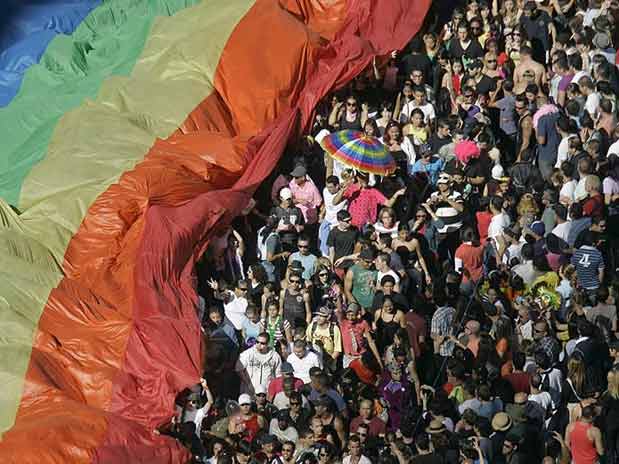 São Paulo hosts the largest gay march in the world. More than three million people march for tolerance in the financial capital of Brazil
 A black and white work of artist Otavio Donasci in the facade of the National Assembly, one of the monuments culture of this city, will mark the starting point of the march.
 However, the rainbow flag will be present at this year's launch of a credit card for gay people, who devoted part of the money raised from financial transactions to non-profit organizations working against sexual discrimination and care for AIDS patients.
 The calculation was made by the consultant Sao Paulo Convention & Visitors Bureau (SPCVB), which also noted the presence of about 400,000 visitors to the city, many of them foreigners.
 Debates and delivery of academic awards to organizations and individuals who defend the freedom of gender, will complete the schedule of activities for the month. Sao Paulo
  The twelfth edition of the march of gay, lesbian, bisexual, transsexual and transgender people in São Paulo today has brought more one million people, according to witnesses, three and a half million, according to the Metropolitan Store (municipal police) and up to five million people according to parade organizers. But, despite discrepancies on the number of participants and a few isolated incidents, the fact is that the Gay Pride event in the financial capital of the country has now ratified as the largest gathering of the gay community in the world.
  Trucks throwing disc jockey blaring electronic music have come in the shadow of the skyscrapers of Sao Paulo's main thoroughfare in a very hot day.
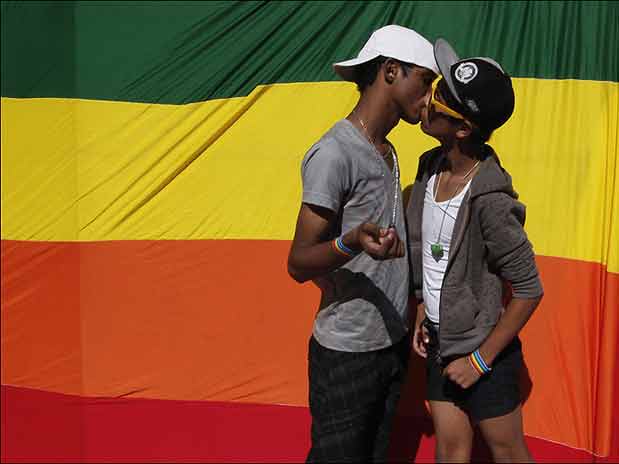 All around, millions of people dressed in wigs, masks, costumes and heavy makeup had danced through the streets of the city for tolerance towards those who have an orientation other than heterosexual sex.
 The march has become an important source of revenue for the city and for tourism in Brazil, since, according to consultants Insearch, gay Brazilians have an average of above-average incomes and spend more in leisure.
  Therefore, the march organizers Fecomercio will launch with a label certifying that the shops are respectful of diversity of race, ethnicity, physical differences and sexual orientation.


 is the guerrilla


